
Learn how to do wall push-ups with perfect form, avoid common mistakes, and discover the best wall push-up variations to build upper-body strength, improve shoulder stability, and develop the foundation for regular push-ups.
Wall push-ups are one of the best beginner-friendly bodyweight exercises for strengthening the chest, shoulders, and triceps. Because the wall supports a large portion of your body weight, wall push-ups are ideal for beginners, older adults, rehabilitation programs, and anyone building strength for their first floor push-up.
Whether you are training for general fitness, calisthenics, military preparation, or injury recovery, mastering wall push-ups is an excellent starting point.
What Are Wall Push-Ups?
A wall push-up is a modified push-up performed against a wall while standing upright. Instead of pushing your body away from the floor, you push yourself away from the wall.
Because the angle is more vertical than a regular push-up, the exercise places less load on the upper body while still strengthening the pushing muscles.
Wall push-ups are commonly used in:
- Beginner strength training
- Rehabilitation programs
- Senior fitness routines
- Push-up progression programs
- Home workouts
They provide a safe and effective way to learn proper push-up mechanics before progressing to harder variations.
Benefits of Wall Push-Ups
Wall push-ups are one of the easiest ways to build pushing strength.
Benefits include:
- Builds chest strength
- Strengthens the shoulders and triceps
- Improves shoulder stability
- Develops proper push-up technique
- Reduces stress on the wrists and joints
- Requires no equipment
Few beginner exercises are as accessible and effective as wall push-ups.
Muscles Worked in Wall Push-Ups
Wall push-ups activate several upper-body muscles simultaneously.
Primary Muscles
- Pectoralis Major (Chest)
- Triceps Brachii
- Anterior Deltoids
Secondary Muscles
- Serratus Anterior
- Core Muscles
- Forearms
- Upper Back Stabilizers
Because of this muscle activation, wall push-ups are an excellent introduction to upper-body pressing exercises.
How to Do Wall Push-Ups (Step-by-Step)
Step 1: Stand Facing a Wall
Stand about an arm’s length away from a sturdy wall.
Place your hands:
- At shoulder height
- Slightly wider than shoulder-width apart
- With fingers pointing upward
Tip: The farther you stand from the wall, the more challenging the exercise becomes.
Step 2: Set Your Body Position
Maintain:
- A straight line from head to heels
- Core engaged
- Chest lifted
- Feet hip-width apart
Avoid arching your lower back.
Step 3: Lower Yourself Toward the Wall
Slowly bend your elbows and bring your chest toward the wall.
Focus on:
- Keeping your elbows at roughly a 30-45° angle from your body
- Maintaining a straight body
- Lowering under control
Bring your chest close to the wall without collapsing.
Step 4: Pause Briefly
At the bottom position:
- Keep your core tight
- Keep your shoulders stable
- Maintain full-body tension
Pause for a moment while staying controlled.
Step 5: Push Back to the Starting Position
Press through your palms until your arms are fully extended.
Finish with:
- Elbows straight but not aggressively locked
- Core engaged
- Body aligned
Repeat for the desired number of repetitions.
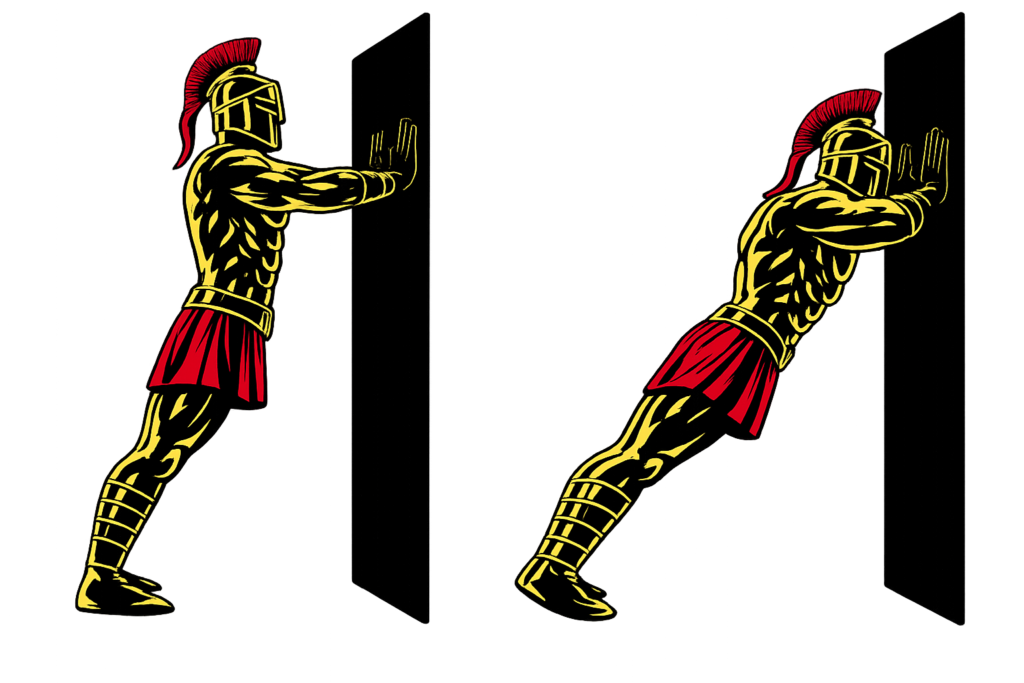
Wall Push-Up Form Checklist
Use this quick checklist to ensure perfect wall push-up form.
- Keep your body straight
- Engage your core
- Lower under control
- Keep your elbows slightly tucked
- Fully extend your arms at the top
Perfect form builds strength faster and reduces joint stress.
Common Wall Push-Up Mistakes
Sagging the Hips
Problem: Places unnecessary stress on the lower back.
Fix: Brace your core and keep your body in a straight line.
Flaring the Elbows
Problem: Increases shoulder strain.
Fix: Keep your elbows angled slightly backward rather than straight out to the sides.
Standing Too Close to the Wall
Problem: Reduces the challenge significantly.
Fix: Step back until the movement feels moderately challenging while maintaining good form.
Using Momentum
Problem: Reduces muscle activation.
Fix: Move slowly and deliberately during both the lowering and pushing phases.
Holding Your Breath
Problem: Increases unnecessary tension.
Fix: Inhale as you lower and exhale as you push away from the wall.
Controlled repetitions always build more strength than fast, sloppy repetitions.
Wall Push-Up Variations
Once you master the basic wall push-up, these progressions can continue building your strength.
Close-Grip Wall Push-Ups
Increases triceps emphasis.
How to Do Close-Grip Wall Push-Ups
- Place your hands closer together
- Keep your elbows tucked
- Perform controlled repetitions
Wide Wall Push-Ups
Increases chest involvement.
How to Do Wide Wall Push-Ups
- Place your hands wider than shoulder-width
- Lower your chest toward the wall
- Push back under control
Incline Push-Ups
The next progression toward floor push-ups.
How to Do Incline Push-Ups
- Place your hands on a bench, table, or sturdy elevated surface
- Keep your body straight
- Perform a regular push-up motion
Knee Push-Ups
An advanced beginner progression.
How to Do Knee Push-Ups
- Start on your knees
- Keep a straight line from head to knees
- Perform controlled push-ups on the floor
Final Thoughts
Wall push-ups are one of the best beginner-friendly pushing exercises you can master.
They build:
- Chest strength
- Triceps strength
- Shoulder stability
- Push-up technique
- Upper-body confidence
Although they are easier than floor push-ups, wall push-ups provide an excellent foundation for developing proper pressing mechanics and building the strength needed for more advanced push-up variations. Learn more about Push Workouts here.
Focus on controlled movement, full-body tension, and gradual progression.
A warrior masters the basics before conquering the floor.
Wall Push-Up FAQ
Q1: Are wall push-ups good for beginners?
Yes. Wall push-ups are one of the safest and most effective beginner exercises for building upper-body strength and learning proper push-up form.
Q2: How many wall push-ups should beginners do?
Most beginners should start with 8-15 repetitions for 2-4 sets while focusing on controlled movement and proper body alignment.
Q3: When should I progress beyond wall push-ups?
Once you can perform 15-20 wall push-ups with excellent form, progress to incline push-ups, knee push-ups, or other more challenging variations to continue building strength.