Learn how to do reverse crunches with perfect form, avoid common mistakes, and discover the best variations to build strong, defined lower abs.
Reverse crunches are one of the most effective bodyweight exercises for targeting the lower abdominal muscles, improving core strength, and enhancing control. Whether you are training for military fitness tests, calisthenics, or athletic performance, mastering reverse crunches is essential.
What Are Reverse Crunches?
A reverse crunch is a bodyweight core exercise where you lift your hips off the ground by bringing your knees toward your chest.
Unlike traditional crunches, reverse crunches emphasize the lower abs rather than the upper abs.
Reverse crunches are commonly used in:
- Core strengthening workouts
- Fat-loss training programs
- Athletic conditioning
- Military fitness routines
This exercise builds real core strength that translates directly into better performance and control.
Benefits of Reverse Crunches
Reverse crunches are one of the best exercises for targeting the lower abs.
Benefits include:
- Strengthens lower abdominal muscles
- Improves core control and stability
- Reduces strain on the neck and upper back
- Enhances pelvic control
- Supports better posture
- Essential for military and tactical fitness
Few exercises isolate the lower abs as effectively as reverse crunches.
Muscles Worked in Reverse Crunches
Reverse crunches activate multiple core muscles.
Primary Muscles
- Lower Abdominals
- Rectus Abdominis
Secondary Muscles
- Obliques
- Hip Flexors
- Lower Back Stabilizers
This makes reverse crunches highly effective for building a strong and controlled core.
How to Do Reverse Crunches (Step-by-Step)
Step 1: Lie Flat on the Ground
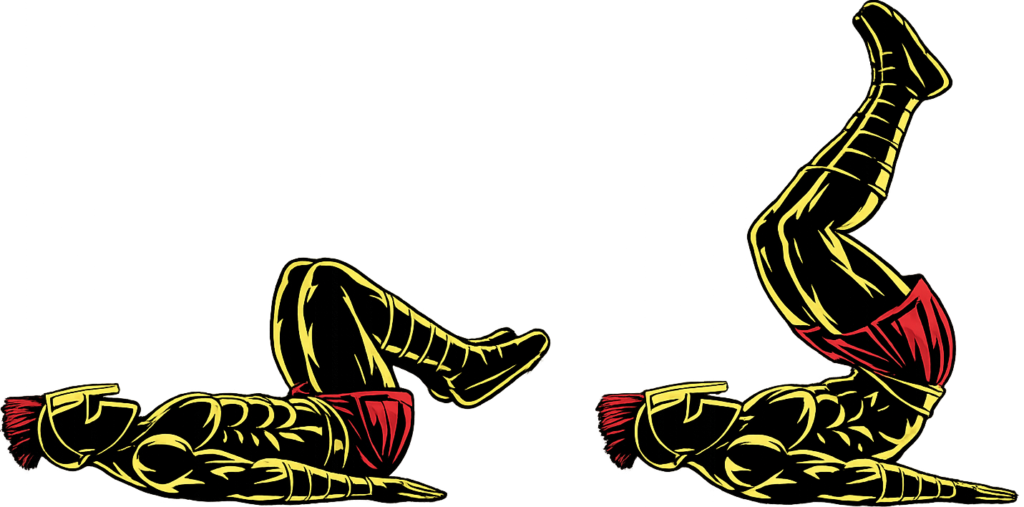
Lie on your back with your arms by your sides and knees bent at 90 degrees.
Tip: Keep your lower back pressed into the ground.
Step 2: Bring Knees Toward Chest
Lift your feet off the ground and bring your knees toward your chest.
- Keep movement controlled
- Core engaged
- Legs relaxed
Step 3: Lift Your Hips
Using your core, lift your hips slightly off the ground.
Focus on curling your pelvis upward rather than swinging your legs.
Step 4: Pause at the Top
At the top of the movement:
- Hips slightly elevated
- Core fully engaged
- Movement controlled
Pause briefly to maximize muscle activation
Step 5: Lower With Control
Slowly lower your hips back down to the starting position.
Avoid dropping your legs quickly — control is key.
Reverse Crunch Form Checklist
Use this checklist to ensure perfect form:
- Keep your lower back pressed into the ground
- Lift hips using your core, not momentum
- Use slow and controlled reps
- Avoid swinging your legs
- Maintain constant tension on the abs
Perfect form builds stronger abs and prevents injury.
Common Reverse Crunch Mistakes
Using Momentum
Problem: Swinging the legs reduces core activation.
Fix: Focus on slow, controlled movement.
Not Lifting the Hips
Problem: Turns the exercise into a basic leg raise.
Fix: Actively curl your pelvis upward.
Arching the Lower Back
Problem: Reduces effectiveness and causes strain.
Fix: Keep your lower back pressed into the ground.
Fast Reps
Problem: Reduces muscle engagement.
Fix: Use a controlled tempo:
- 1–2 seconds up
- 2–3 seconds down
Pulling With Legs Instead of Core
Problem: Shifts focus away from abs.
Fix: Initiate movement from your core.
Reverse Crunch Variations
Once you master the basic reverse crunch, these variations can increase difficulty and effectiveness.
Assisted Reverse Crunch (Beginner Variation)
Easier version for beginners.
How to Do Assisted Reverse Crunch
- Place hands under hips for support
- Perform a smaller range of motion
- Focus on control
Hanging Reverse Crunch
A more advanced version using a pull-up bar.
How to Do Hanging Reverse Crunch
- Hang from a bar with legs extended
- Bring your knees toward your chest
- Lift hips slightly upward
Decline Reverse Crunch
Increases resistance and range of motion.
How to Do Decline Reverse Crunch
- Lie on a decline bench
- Perform reverse crunch with controlled movement
- Focus on lifting hips
Straight-Leg Reverse Crunch
Adds intensity by keeping legs straight.
How to Do Straight-Leg Reverse Crunch
- Keep legs extended
- Lift hips using core strength
- Lower slowly with control
Final Thoughts
Reverse crunches are one of the most effective lower ab exercises you can master.
They build:
- Lower ab strength
- Core stability
- Pelvic control
- Functional athletic strength
- Improved body control
Progress may feel slow at first, especially when learning to control the movement. However, with consistent training and proper form, your core strength will steadily improve. Learn more about Core Workouts here.
Focus on control — not speed.
A warrior trains the core with precision — not momentum.
FAQ
Q1: Are reverse crunches better than regular crunches?
Reverse crunches are better for targeting the lower abs, while regular crunches focus more on the upper abs. Both have their place in a complete core routine.
Q2: How many reverse crunches should beginners do?
Beginners can start with 10–15 reps per set and gradually increase as strength improves.
Q3: How often should I do reverse crunches?
You can train reverse crunches 3–5 times per week as part of your core routine, depending on recovery.