
Learn how to do mountain climbers with perfect form, avoid common mistakes, and discover the best variations to build a strong core and elite conditioning.
Mountain climbers are one of the most effective bodyweight exercises for developing core strength, improving cardiovascular endurance, and burning fat. Whether you are training for military fitness tests, calisthenics, or athletic performance, mastering mountain climbers is essential.
What Are Mountain Climbers?
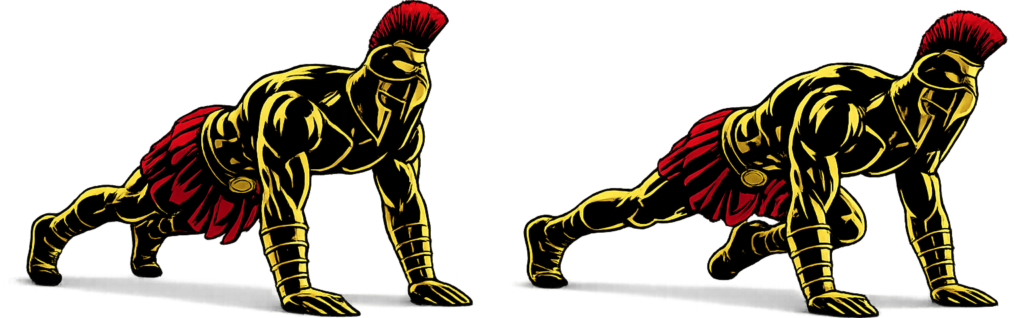
Mountain climbers are a dynamic bodyweight exercise performed in a high plank position where you rapidly drive your knees toward your chest in an alternating motion.
This exercise combines core training with cardio, making it highly effective for full-body conditioning.
Mountain climbers are commonly used in:
- Military fitness training
- HIIT (High-Intensity Interval Training) workouts
- Fat-loss programs
- Athletic conditioning
Unlike static exercises, mountain climbers train both strength and endurance simultaneously.
Benefits of Mountain Climbers
Mountain climbers are one of the most powerful exercises for building endurance and core strength.
Benefits include:
- Strengthens the core and abs
- Improves cardiovascular endurance
- Burns calories and supports fat loss
- Enhances coordination and agility
- Builds full-body endurance
- Essential for military and tactical fitness
Few exercises combine cardio and strength as effectively as mountain climbers.
Muscles Worked in Mountain Climbers
Mountain climbers activate multiple muscle groups across the body.
Primary Muscles
- Rectus Abdominis
- Lower Abdominals
- Hip Flexors
Secondary Muscles
- Shoulders (Deltoids)
- Chest (Pectorals)
- Quadriceps
- Hamstrings
- Glutes
This makes mountain climbers a highly effective full-body exercise.
How to Do Mountain Climbers (Step-by-Step)
Step 1: Get Into a High Plank Position
Start in a push-up position with:
- Hands directly under shoulders
- Arms fully extended
- Body in a straight line
Tip: Engage your core to maintain stability.
Step 2: Drive One Knee Toward Your Chest
Bring one knee forward toward your chest.
- Keep your core tight
- Avoid lifting your hips too high
Step 3: Switch Legs Quickly
Return the leg to the starting position and immediately switch legs.
- Alternate knees in a running motion
- Keep movement controlled
Step 4: Maintain Proper Form
Throughout the movement:
- Keep hips low
- Maintain a straight body line
- Engage your core continuously
Step 5: Control Your Speed
Perform the exercise at a steady pace.
Avoid going too fast — proper form is more important than speed.
Mountain Climbers Form Checklist
Use this checklist to ensure perfect form:
- Keep your body in a straight line
- Engage your core throughout
- Keep hips low and stable
- Drive your knees toward your chest
- Control your movement
Perfect form maximizes results and prevents injury.
Common Mountain Climbers Mistakes
Hips Too High
Problem: Reduces core engagement.
Fix: Keep your body in a straight plank position.
Moving Too Fast
Problem: Leads to poor form and less effectiveness.
Fix: Focus on controlled movement before increasing speed.
Not Engaging the Core
Problem: Turns it into a leg exercise.
Fix: Keep your abs tight throughout.
Short Range of Motion
Problem: Limits effectiveness.
Fix: Bring knees fully toward your chest.
Bouncing or Sloppy Form
Problem: Reduces muscle activation.
Fix: Stay controlled and stable.
Mountain Climbers Variations
Once you master basic mountain climbers, these variations can increase intensity and effectiveness.
Slow Mountain Climbers
Focuses on control and core strength.
How to Do Slow Mountain Climbers
- Perform the movement slowly
- Hold each knee drive briefly
- Maintain strict plank form
Cross-Body Mountain Climbers
Targets the obliques more effectively.
How to Do Cross-Body Mountain Climbers
- Drive your knee toward the opposite elbow
- Keep your core tight
- Move in a controlled manner
Elevated Mountain Climbers
Increases upper-body involvement.
How to Do Elevated Mountain Climbers
- Place hands on an elevated surface
- Perform standard movement
- Maintain stability
Sliding Mountain Climbers (Advanced)
Adds instability and difficulty.
How to Do Sliding Mountain Climbers
- Place feet on sliders or a smooth surface
- Slide knees toward your chest
- Control the movement throughout
Final Thoughts
Mountain climbers are one of the most effective full-body exercises you can master.
They build:
- Core strength
- Cardiovascular endurance
- Full-body coordination
- Fat-burning capacity
- Functional athletic performance
Progress may feel challenging at first, especially when maintaining form under fatigue. However, with consistent training and proper technique, your endurance and strength will rapidly improve. Learn more about Conditioning Exercises here.
Focus on control before speed.
A warrior moves with precision — even at high intensity.
Mountain Climbers FAQ
Q1: How long should beginners do mountain climbers?
Beginners can start with 20–30 seconds per set and gradually increase to 45–60 seconds.
Q2: Are mountain climbers good for fat loss?
Yes, mountain climbers are excellent for burning calories and improving overall conditioning.
Q3: How often should I do mountain climbers?
You can train mountain climbers 3–5 times per week as part of your workouts, depending on recovery.