
Learn how to do hanging leg raises with perfect form, avoid common mistakes, and discover the best hanging leg raise variations to build a stronger core, improve grip strength, and develop exceptional body control.
Hanging leg raises are one of the most effective bodyweight core exercises for developing the lower abdominals, hip flexors, and grip strength. Whether you are training for calisthenics, military fitness, gymnastics, or athletic performance, mastering hanging leg raises is essential.
What Are Hanging Leg Raises?
A hanging leg raise is a bodyweight exercise performed while hanging from a pull-up bar, where you raise your straight legs until they are parallel to the floor or higher while keeping your body under control.
Hanging leg raises are considered one of the best core exercises because they challenge the abdominals through a large range of motion while requiring significant grip strength and shoulder stability.
Hanging leg raises are commonly used in:
- Calisthenics training
- Gymnastics programs
- Military fitness preparation
- Core strengthening routines
Unlike floor-based abdominal exercises, hanging leg raises train the core while your body resists swinging, making them highly functional.
Benefits of Hanging Leg Raises
Hanging leg raises are one of the most effective exercises for building functional core strength.
Benefits include:
- Builds powerful lower abdominal muscles
- Improves grip strength
- Strengthens the hip flexors
- Enhances shoulder stability
- Develops body control
- Improves performance in advanced calisthenics skills
Few bodyweight exercises develop core strength as effectively as hanging leg raises.
Muscles Worked in Hanging Leg Raises
Hanging leg raises activate several muscles throughout the body simultaneously.
Primary Muscles
- Rectus Abdominis
- Hip Flexors
Secondary Muscles
- Transverse Abdominis
- Internal and External Obliques
- Forearms and Grip Muscles
- Latissimus Dorsi
- Anterior Deltoids
- Serratus Anterior
Because of this muscle activation, hanging leg raises are one of the best exercises for building a strong and stable core.
How to Do Hanging Leg Raises (Step-by-Step)
Step 1: Grip the Pull-Up Bar
Grab the pull-up bar with:
- Hands approximately shoulder-width apart
- Palms facing away from you
- A firm, secure grip
Tip: Use an active hang by pulling your shoulders slightly down instead of relaxing completely.
Step 2: Start in an Active Hang
Begin with:
- Arms fully extended
- Legs together
- Core engaged
- Body completely still
Avoid swinging before beginning the movement.
Step 3: Raise Your Legs
Keeping your legs as straight as possible, lift them in front of your body.
Focus on:
- Using your abdominal muscles
- Keeping your knees extended
- Moving slowly and under control
Raise your legs until they reach at least parallel to the floor.
Step 4: Pause at the Top
At the highest position:
- Briefly squeeze your abdominal muscles
- Keep your body stable
- Avoid swinging backward
Maintain full control before lowering.
Step 5: Lower With Control
Slowly lower your legs back to the starting position.
Return to a stable active hang before beginning the next repetition.
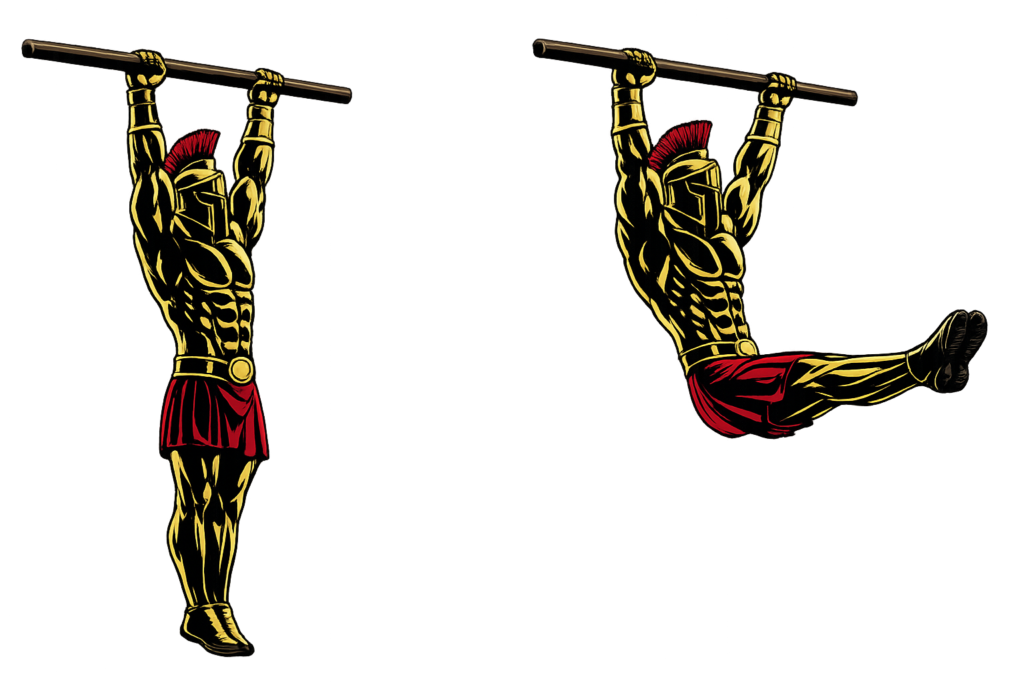
Hanging Leg Raise Form Checklist
Use this quick checklist to ensure perfect hanging leg raise form.
- Start from an active hang
- Keep your legs together
- Raise your legs using your core
- Minimize swinging
- Control every repetition
Perfect form builds stronger abs and better body control.
Common Hanging Leg Raise Mistakes
Swinging the Body
Problem: Momentum reduces core activation.
Fix: Pause between repetitions until your body becomes still.
Bending the Knees Excessively
Problem: Makes the exercise easier and reduces abdominal demand.
Fix: Keep your legs as straight as your mobility allows.
Using Momentum
Problem: Transfers the workload away from the core.
Fix: Lift and lower your legs under complete control.
Lowering Too Quickly
Problem: Reduces time under tension.
Fix: Lower your legs slowly over two to three seconds.
Shrugging the Shoulders
Problem: Places unnecessary stress on the neck and shoulders.
Fix: Keep your shoulders active by pulling them slightly downward throughout the exercise.
Controlled repetitions always build more strength than fast ones.
Hanging Leg Raise Variations
Once you master the basic hanging leg raise, different variations can help increase strength and develop advanced core control.
Hanging Knee Raises
The easiest progression.
How to Do Hanging Knee Raises
- Bend your knees
- Raise them toward your chest
- Lower under control
This variation builds the foundational strength needed for straight-leg raises.
Alternating Hanging Leg Raises
Improves coordination and unilateral strength.
How to Do Alternating Hanging Leg Raises
- Raise one straight leg at a time
- Alternate sides
- Minimize body movement
This variation develops better balance and control.
Toes-to-Bar
An advanced progression.
How to Do Toes-to-Bar
- Raise your straight legs until your toes touch the pull-up bar
- Keep the movement controlled
- Lower slowly
This variation requires exceptional core strength and flexibility.
L-Sit Leg Raises
Develops static and dynamic core strength.
How to Do L-Sit Leg Raises
- Hold an L-sit position while hanging
- Perform small controlled leg raises
- Maintain full-body tension
This variation significantly increases core and hip flexor demand.
Final Thoughts
Hanging leg raises are one of the most effective bodyweight core exercises you can master.
They build:
- Core strength
- Lower abdominal development
- Grip strength
- Hip flexor strength
- Functional body control
Progress may feel challenging at first because hanging leg raises demand strength, coordination, and stability simultaneously. However, with consistent training and proper technique, your core strength and athletic performance will steadily improve. Learn more about Core Workouts here.
Every controlled repetition builds a stronger foundation than a rushed set.
Focus on smooth movement, minimal swinging, and full-body tension.
A warrior controls every inch of every movement.
Hanging Leg Raise FAQ
Q1: Are hanging leg raises better than lying leg raises?
Yes. Hanging leg raises are generally more challenging because they require greater core activation, grip strength, and shoulder stability while eliminating support from the floor.
Q2: How many hanging leg raises should beginners do?
Most beginners should start with 6-10 controlled repetitions for 2-4 sets. If straight-leg raises are too difficult, begin with hanging knee raises.
Q3: Do hanging leg raises build visible abs?
Yes. Hanging leg raises strengthen the entire abdominal wall, particularly the lower portion of the rectus abdominis. Combined with proper nutrition and a healthy body fat percentage, they can help develop more defined abdominal muscles.