
Learn how to do bench dips with perfect form, avoid common mistakes, and discover the best bench dip variations to build stronger triceps, improve upper-body strength, and develop pushing endurance.
Bench dips are one of the most effective beginner-friendly bodyweight exercises for developing triceps strength and improving upper-body endurance. Whether you are training at home, in the gym, or progressing toward parallel bar dips, mastering bench dips is an excellent way to build pressing strength.
What Are Bench Dips?
A bench dip is a bodyweight exercise performed by placing your hands on a bench or sturdy elevated surface behind you while lowering and raising your body using your arms.
Bench dips primarily target the triceps while also strengthening the chest and shoulders, making them an excellent progression toward more advanced dip variations.
Bench dips are commonly used in:
- Beginner strength training
- Home workouts
- Upper-body conditioning
- Calisthenics progressions
Unlike parallel bar dips, bench dips require less upper-body strength, making them accessible for most beginners.
Benefits of Bench Dips
Bench dips are one of the most effective exercises for building upper-body pushing strength.
Benefits include:
- Builds stronger triceps
- Improves pushing endurance
- Strengthens the chest and shoulders
- Requires minimal equipment
- Helps prepare for parallel bar dips
- Easy to perform at home
Few beginner exercises strengthen the triceps as effectively as bench dips.
Muscles Worked in Bench Dips
Bench dips activate several upper-body muscles simultaneously.
Primary Muscles
- Triceps Brachii
Secondary Muscles
- Pectoralis Major
- Anterior Deltoids
- Serratus Anterior
- Forearms
- Core Muscles
Because of this muscle activation, bench dips are one of the best beginner exercises for developing upper-body pushing strength.
How to Do Bench Dips (Step-by-Step)
Step 1: Set Up Your Position
Sit on the edge of a sturdy bench or chair.
Place your hands:
- Beside your hips
- Fingers pointing forward
- Hands approximately shoulder-width apart
Extend your legs in front of you.
Tip: Beginners can keep their knees bent to reduce the difficulty.
Step 2: Slide Forward
Move your hips just in front of the bench.
Maintain:
- Arms fully extended
- Chest lifted
- Shoulders pulled down and back
- Core engaged
Your back should stay close to the bench throughout the movement.
Step 3: Lower Your Body
Slowly bend your elbows to lower yourself.
Focus on:
- Keeping your elbows pointing backward
- Lowering until your elbows reach approximately 90 degrees
- Keeping your shoulders stable
Avoid allowing your shoulders to roll excessively forward.
Step 4: Pause Briefly
At the bottom position:
- Keep your chest open
- Maintain tension in your triceps
- Keep your hips close to the bench
Pause briefly without relaxing.
Step 5: Press Back Up
Push through your palms to straighten your arms.
Finish with:
- Elbows fully extended
- Core engaged
- Shoulders stable
Repeat for the desired number of repetitions.
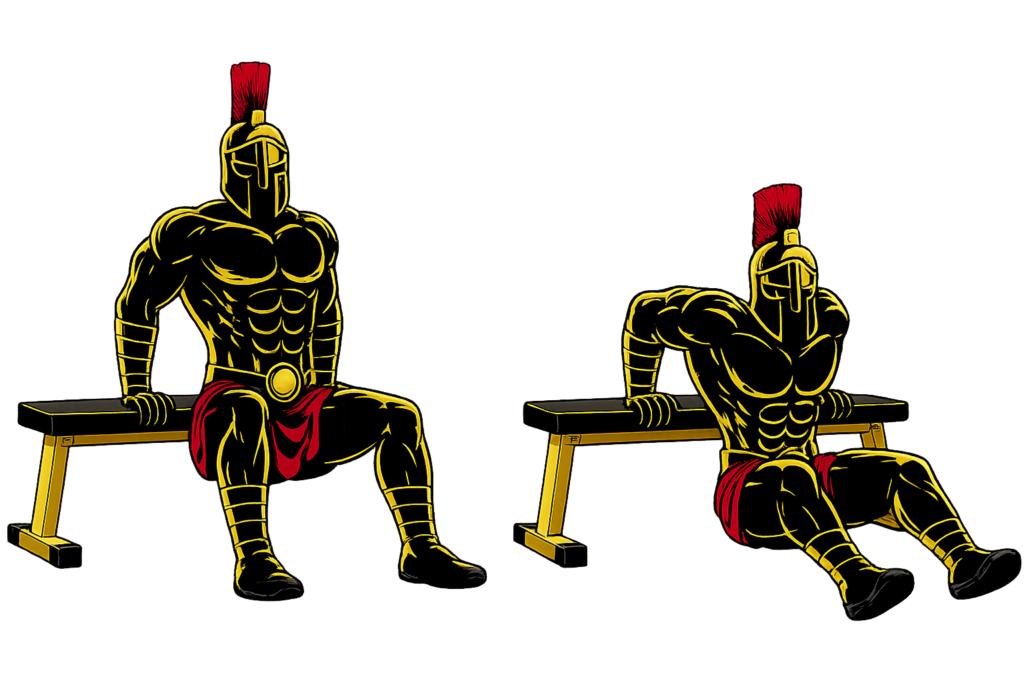
Bench Dip Form Checklist
Use this quick checklist to ensure perfect bench dip form.
- Keep your back close to the bench
- Lower under control
- Keep your elbows pointing backward
- Avoid shrugging your shoulders
- Fully extend your arms at the top
Perfect form builds strength while reducing unnecessary shoulder stress.
Common Bench Dip Mistakes
Lowering Too Deep
Problem: Excessive shoulder extension may place unnecessary stress on the shoulder joint.
Fix: Lower only until your elbows reach approximately a 90-degree angle or a comfortable pain-free range of motion.
Letting the Elbows Flare Out
Problem: Reduces triceps activation and increases shoulder strain.
Fix: Keep your elbows close to your body throughout the movement.
Moving Away From the Bench
Problem: Places additional stress on the shoulders.
Fix: Keep your hips close to the bench during every repetition.
Using Momentum
Problem: Reduces muscle activation.
Fix: Perform slow, controlled repetitions.
Locking the Shoulders Upward
Problem: Creates unnecessary neck and shoulder tension.
Fix: Keep your shoulders depressed and relaxed throughout the exercise.
Controlled repetitions always build more strength than rushed repetitions.
Bench Dip Variations
Once you master the basic bench dip, different variations can help increase or decrease the difficulty.
Bent-Knee Bench Dips
The easiest progression.
How to Do Bent-Knee Bench Dips
- Bend your knees approximately 90 degrees
- Keep your feet flat on the floor
- Perform controlled repetitions
This variation reduces the amount of bodyweight being lifted.
Straight-Leg Bench Dips
The standard variation.
How to Do Straight-Leg Bench Dips
- Extend both legs fully
- Keep your heels on the floor
- Perform the movement under control
This variation increases the load on your upper body.
Elevated Feet Bench Dips
An advanced progression.
How to Do Elevated Feet Bench Dips
- Place your heels on a second bench or sturdy platform
- Perform strict bench dips
- Lower under complete control
This variation significantly increases resistance.
Weighted Bench Dips
The most challenging progression.
How to Do Weighted Bench Dips
- Place a weight plate on your thighs or wear a weighted vest
- Perform controlled repetitions
- Maintain perfect form throughout
This variation develops greater triceps strength and muscular endurance.
Final Thoughts
Bench dips are one of the best beginner-friendly pushing exercises you can master.
They build:
- Triceps strength
- Chest strength
- Shoulder endurance
- Upper-body control
- Functional pushing power
Although bench dips are an excellent progression exercise, they should eventually be supplemented with parallel bar dips as your strength improves. Parallel bar dips provide a more natural shoulder position and develop greater overall pushing strength. Learn more about Push Workouts here.
Focus on smooth repetitions, controlled movement, and gradual progression.
A warrior builds strength one controlled repetition at a time.
Bench Dip FAQ
Q1: Are bench dips good for beginners?
Yes. Bench dips are one of the best beginner exercises for strengthening the triceps and building the pushing strength needed for more advanced exercises like parallel bar dips.
Q2: Are bench dips as effective as parallel bar dips?
Bench dips are effective for developing the triceps, but parallel bar dips generally activate more muscles, provide a greater range of motion, and are considered the superior overall upper-body pushing exercise.
Q3: How many bench dips should beginners do?
Most beginners should perform 8-15 repetitions for 2-4 sets while maintaining proper form and avoiding excessive shoulder strain.