Learn how to do a one-arm plank with perfect form, avoid common mistakes, and discover the best one-arm plank variations to build core strength, improve shoulder stability, and develop total-body balance.
The one-arm plank is an advanced core exercise that challenges your stability by reducing your base of support. Unlike a standard plank, lifting one arm forces your core to resist rotation while your supporting arm and shoulder stabilize your entire body weight. Whether you’re training for calisthenics, military fitness, combat sports, or general athletic performance, mastering the one-arm plank will improve your balance, coordination, and core strength.
What Is a One-Arm Plank?
A one-arm plank is an advanced variation of the traditional plank performed by supporting your body with one hand while the opposite arm is extended forward or placed alongside your body.
Because only one arm supports the upper body, the exercise significantly increases the demand on your core, shoulders, and stabilizing muscles.
One-arm planks are commonly used in:
- Calisthenics training
- Military fitness programs
- Functional strength workouts
- Athletic conditioning
- Core stability training
The one-arm plank is an excellent progression once you have mastered the standard plank.
Benefits of One-Arm Planks
One-arm planks provide numerous strength and stability benefits.
Benefits include:
- Builds exceptional core strength
- Improves anti-rotation stability
- Strengthens the shoulders
- Develops balance and coordination
- Increases body awareness
- Improves overall athletic performance
- Requires no equipment
Few bodyweight exercises challenge your core and shoulder stability as effectively as the one-arm plank.
Muscles Worked in One-Arm Planks
One-arm planks engage nearly every major stabilizing muscle throughout the body.
Primary Muscles
- Rectus Abdominis
- Transverse Abdominis
- Internal and External Obliques
- Anterior Deltoids
Secondary Muscles
- Serratus Anterior
- Pectoralis Major
- Triceps Brachii
- Gluteus Maximus
- Quadriceps
- Lower Back Muscles
Because of this muscle activation, one-arm planks are one of the best exercises for developing full-body stability.
How to Do a One-Arm Plank (Step-by-Step)
Step 1: Begin in a High Plank
Start in a standard high plank position.
Place:
- One hand directly beneath your shoulder
- Feet wider than shoulder-width apart
- Body in a straight line from head to heels
Tip: A wider foot position provides greater stability while learning the exercise.
Step 2: Brace Your Core
Before lifting your arm:
- Tighten your abdominal muscles
- Squeeze your glutes
- Keep your legs straight
- Maintain a neutral neck
Your body should remain rigid throughout the exercise.
Step 3: Lift One Arm
Slowly lift one hand off the floor.
Either:
- Extend the arm straight in front of you
- Keep it resting alongside your body
Avoid shifting your hips or rotating your torso.
Step 4: Hold the Position
Maintain the plank while focusing on:
- Keeping your hips level
- Breathing steadily
- Maintaining shoulder stability
- Keeping your core fully engaged
Hold for the desired amount of time.
Step 5: Return and Switch Sides
Slowly place your hand back on the floor.
Reset your position before repeating the hold on the opposite arm.
Alternate sides evenly.
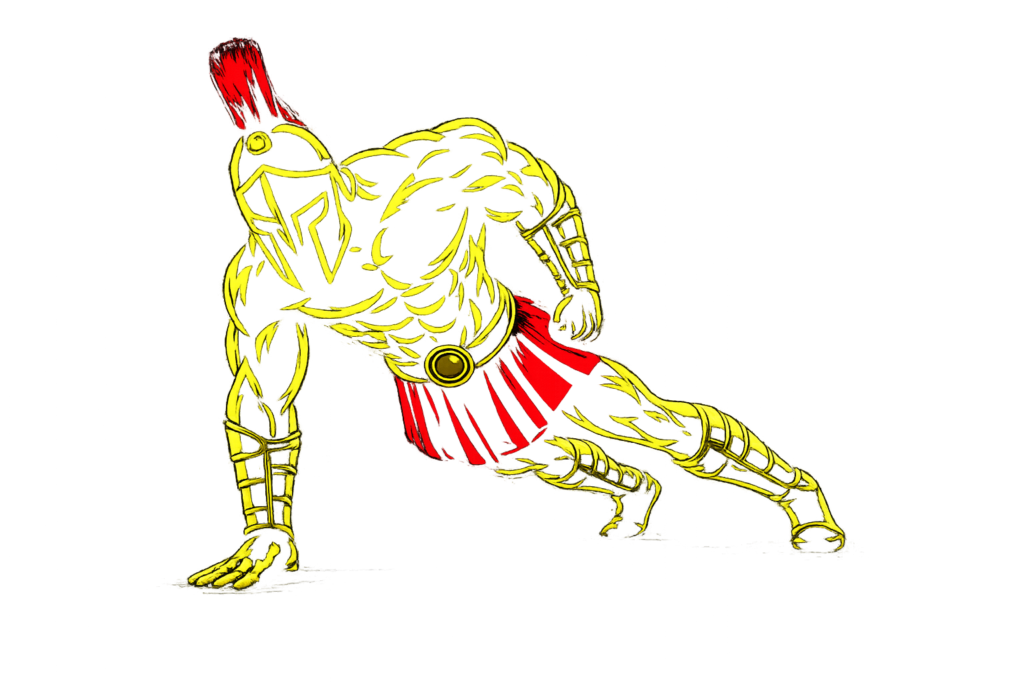
One-Arm Plank Form Checklist
Use this quick checklist to ensure perfect one-arm plank form.
- Keep your body straight
- Brace your core throughout
- Keep your hips level
- Support yourself directly under your shoulder
- Breathe normally during the hold
Perfect form develops greater stability while reducing unnecessary strain.
Common One-Arm Plank Mistakes
Rotating the Hips
Problem: Reduces core activation and makes the exercise less effective.
Fix: Keep your hips square to the floor throughout the hold.
Raising the Hips Too High
Problem: Reduces tension on the core.
Fix: Maintain a straight line from your head to your heels.
Letting the Hips Sag
Problem: Places unnecessary stress on the lower back.
Fix: Brace your core and squeeze your glutes throughout the exercise.
Holding Your Breath
Problem: Creates unnecessary tension and reduces endurance.
Fix: Take slow, controlled breaths throughout the hold.
Looking Forward
Problem: Places unnecessary strain on the neck.
Fix: Keep your head neutral and look at the floor a short distance in front of your supporting hand.
Controlled holds build more stability than longer holds with poor form.
One-Arm Plank Variations
Once you master the standard one-arm plank, these variations can further improve your stability and core strength.
Knee One-Arm Plank
The easiest progression.
How to Do Knee One-Arm Planks
- Begin on your knees instead of your toes
- Lift one hand while maintaining a straight line from your head to your knees
- Hold under control
This variation reduces the amount of bodyweight you must stabilize.
One-Arm Plank with Shoulder Tap
Builds dynamic stability.
How to Do One-Arm Plank with Shoulder Taps
- Begin in a high plank
- Lift one hand and tap the opposite shoulder
- Return to the floor and alternate sides
This variation improves coordination and anti-rotation strength.
One-Arm Side Plank
Increases oblique activation.
How to Do One-Arm Side Planks
- Rotate into a side plank
- Support yourself on one hand
- Extend your free arm toward the ceiling
- Hold under control
This variation emphasizes lateral core stability.
One-Arm Plank with Leg Lift
The most advanced progression.
How to Do One-Arm Plank with Leg Lift
- Perform a one-arm plank
- Lift the opposite leg slightly off the floor
- Maintain a stable body position throughout the hold
This variation significantly increases the balance and core demands.
Final Thoughts
The one-arm plank is one of the best bodyweight exercises for building total-body stability and core strength.
It develops:
- Core strength
- Shoulder stability
- Balance
- Anti-rotation control
- Athletic performance
Although it is an advanced exercise, mastering the one-arm plank will improve your performance in countless sports and bodyweight movements. Focus on maintaining perfect alignment rather than holding the position for excessive time. Learn more about Core Workouts here.
Quality always beats duration.
A warrior’s strength is measured by the control he maintains under pressure.
One-Arm Plank FAQ
Q1: Is a one-arm plank harder than a regular plank?
Yes. A one-arm plank is significantly more challenging because supporting your body with one arm greatly increases the demand on your core, shoulders, and stabilizing muscles.
Q2: How long should beginners hold a one-arm plank?
Most beginners should aim to hold the position for 10-20 seconds per side for 2-4 sets while maintaining perfect form.
Q3: Do one-arm planks help improve sports performance?
Yes. One-arm planks improve balance, anti-rotation strength, shoulder stability, and core control, making them beneficial for calisthenics, martial arts, running, climbing, military fitness, and many other athletic activities.