
Leg swings are especially effective for preparing your body for movements like sprinting, squats, lunges, and jumping exercises. Since they require no equipment, they are ideal for home workouts and pre-training routines.
What Are Leg Swings?
Leg swings are a dynamic mobility exercise that involves swinging one leg forward and backward in a controlled motion to warm up the hip joints and surrounding muscles.
They are widely used in warm-ups for running, calisthenics, sports training, and military fitness routines because they help improve flexibility and activate the lower body.
Benefits of Leg Swings
Adding leg swings to your routine provides several key benefits.
1. Improves Hip Flexibility
Leg swings increase the range of motion in the hip joint.
2. Activates Lower Body Muscles
They prepare the glutes, hamstrings, and hip flexors for exercise.
3. Enhances Athletic Performance
Better hip mobility improves running, jumping, and kicking movements.
4. Reduces Risk of Injury
Dynamic movement helps prevent muscle strains during workouts.
5. Improves Balance and Coordination
Standing on one leg builds stability and control.
Muscles Worked
Leg swings activate several important lower-body muscles.
Primary Muscles
- Hip flexors
- Hamstrings
Secondary Muscles
- Glutes
- Quadriceps
- Core muscles
- Lower back stabilizers
These muscles work together to improve hip mobility, balance, and coordination.
How to Do Leg Swings Properly
Step-by-Step Instructions
- Stand upright next to a wall or support for balance.
- Place one hand on the support.
- Keep your chest up and core engaged.
- Shift your weight onto one leg.
- Begin swinging the opposite leg in a controlled motion.
Perform the movement smoothly without forcing the range of motion.
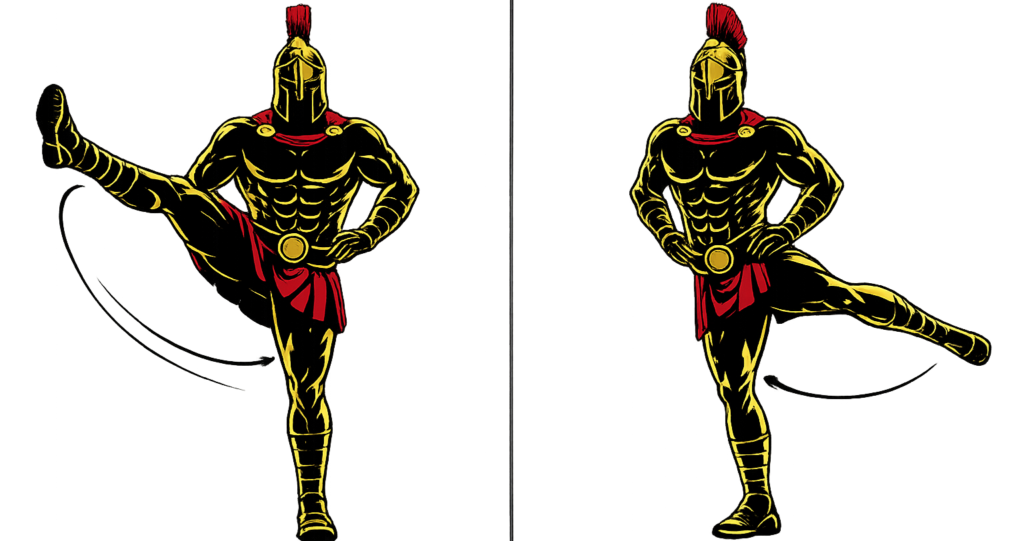
Front and Back Leg Swings
Front and back leg swings are the most common variation and are essential for warming up the hips.
How to Do Front Leg Swings (Forward Phase)
- Swing your leg forward in front of your body.
- Keep your leg straight or slightly bent.
- Raise it to a comfortable height.
- Maintain balance and control.
Muscles Activated
- Hip flexors
- Quadriceps
- Core muscles
How to Do Back Leg Swings (Backward Phase)
- Swing your leg backward behind your body.
- Keep your upper body stable.
- Avoid excessive arching of the lower back.
- Return smoothly to the starting position.
Muscles Activated
- Glutes
- Hamstrings
- Lower back stabilizers
Common Mistakes to Avoid
1. Swinging Too Fast
Leg swings should be controlled, not rushed.
2. Using Momentum Instead of Muscle Control
Focus on muscle engagement, not just swinging the leg.
3. Leaning Too Far Forward or Backward
Keep your torso upright to maintain proper form.
4. Overextending the Leg
Do not force the range of motion beyond your flexibility.
Final Thoughts
Leg swings are one of the most effective dynamic warm-up exercises for the lower body. They improve hip mobility, activate key muscle groups, and prepare your body for intense physical activity.
By performing controlled front and back leg swings, you can increase flexibility, reduce injury risk, and enhance your overall performance. Learn more about Stretching Here.
Adding leg swings to your routine takes less than a minute, but it can significantly improve your workout quality.
FAQ
Q1. Should leg swings be done forward and backward?
Yes, performing leg swings in both directions ensures balanced muscle activation and better hip mobility.
Q2. Do leg swings improve flexibility?
Yes, leg swings increase hip flexibility and range of motion over time.
Q3. Do leg swings help prevent injuries?
Yes, leg swings help reduce injury risk by warming up muscles and improving joint mobility.