
The Sit-up is a classic core exercise that builds abdominal strength, hip flexor coordination, and overall trunk stability—when done correctly. However, poor form can strain your lower back and neck. Here’s how to do them the right way.
What is a Sit-Up?
A sit-up is a classic core-strengthening exercise that involves lifting your upper body from a lying position to a seated position using your abdominal muscles. Unlike crunches, which involve a smaller range of motion, sit-ups require your torso to move through a fuller arc, engaging not only the abdominals but also the hip flexors and stabilizing muscles.
The primary muscles worked during a sit-up are the rectus abdominis (the “six-pack” muscle) and the hip flexors, while the obliques and lower back stabilizers assist in controlling the movement. Sit-ups help build core strength, endurance, and overall trunk stability, which are essential for posture, balance, and athletic performance.
Benefits of Sit-Ups
- Stronger core muscles
- Better posture and stability
- Improved athletic performance
- Increased abdominal endurance
Muscles Worked
- Rectus abdominis (six-pack muscles)
- Hip flexors
- Obliques (secondary)
- Lower back stabilizers
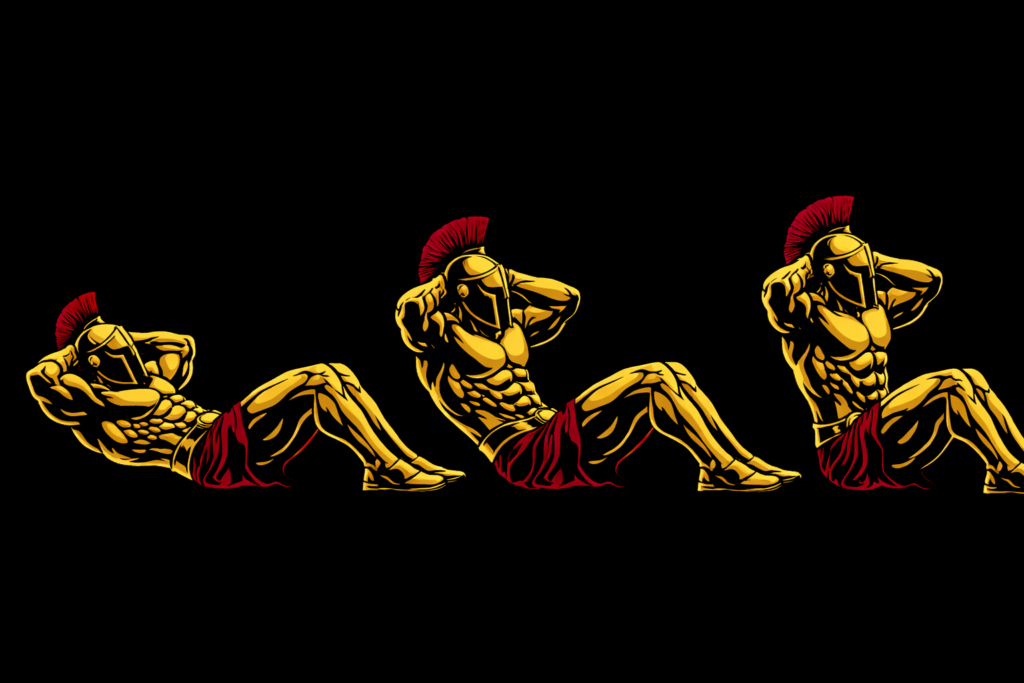
How to Do a Sit-Up Properly (Step-by-Step)
Steps
- Lie flat on your back on the floor or mat
- Bend your knees and place your feet flat on the ground
- Cross arms over chest or place fingertips lightly behind ears
- Engage your core and press your lower back into the floor
- Exhale and curl your torso upward using your abs
- Sit up until your chest is close to your thighs
- Lower yourself back down under control
Tip: Control matters more than speed. Each rep should be smooth and deliberate.
Breathing Technique
- Exhale while sitting up
- Inhale as you lower back down
Proper breathing improves core engagement and endurance.
Sit-Up Form Checklist
- Feet grounded and stable – Keep your feet flat on the floor with knees bent at about 90°.
- Engage your core first – Tighten your abs before lifting your torso.
- Neutral neck position – Keep your neck relaxed and your gaze forward or slightly upward.
- Controlled full range of motion – Lift until your torso reaches your thighs, then lower slowly.
- Slow, steady tempo – Avoid momentum; move with control on both the way up and down.
Common Sit-Up Mistakes (And How to Fix Them)
❌ Pulling the neck with hands
Fix: Keep your hands lightly touching your head or crossed on your chest and lift using your core, not your neck.
❌ Using momentum instead of core strength
Fix: Perform slow, controlled reps and focus on lifting your torso using your abdominal muscles.
❌ Lifting feet off the ground
Fix: Keep your feet firmly planted and press your heels into the floor for stability.
❌ Arching the lower back excessively
Fix: Engage your core and keep your lower back controlled as you lower down.
❌ Rushing reps without control
Fix: Use a steady tempo, lifting and lowering slowly to maintain tension and proper form.
Sit-Up Variations for Beginners
1. Assisted Sit-Up
- Lie on your back with knees bent and feet lightly anchored
- Cross your arms over your chest and brace your core
- Sit up smoothly, then lower yourself back down with control
2. Partial Sit-Up
- Lie flat with knees bent and feet on the floor
- Lift your upper body halfway while keeping the lower back down
- Slowly return to the starting position without dropping
3. Crunch Sit-Up
- Lie on your back with your knees bent and your hands on your chest
- Lift your shoulders and upper back off the floor using your abs
- Lower down slowly while keeping tension in the core
4. Bent-Knee Sit-Up
- Lie down with knees bent tightly and feet planted
- Engage your core and sit up until your chest reaches your thighs
- Lower back down slowly to maintain control
5. Feet-Elevated Sit-Up
- Lie on your back and place your feet on a bench or step
- Brace your core and sit up without using momentum
- Lower yourself back down in a slow, controlled motion
Final Thoughts
The Sit-up is a classic core exercise, but its effectiveness depends entirely on proper form. When done correctly, sit-ups can strengthen your abdominal muscles, improve core stability, and support better posture and athletic performance. Focus on controlled movement, steady breathing, and engaging your core rather than relying on momentum. If sit-ups feel uncomfortable on your lower back, start with easier core exercises and progress gradually. Consistency and good technique will always beat high reps with poor form. Learn more about Core Workouts here.
FAQ
1. Are sit-ups bad for your lower back?
Sit-ups are not bad if performed with proper form and control. Problems usually occur when people pull on their neck, rush the movement, or overextend their lower back. If you have existing back pain, core exercises like crunches or planks may be safer alternatives.
2. How many sit-ups should I do daily?
For beginners, 2–3 sets of 10–15 sit-ups are enough. Intermediate trainees can aim for 20–30 reps per set. Focus on quality reps rather than chasing high numbers.
3. Do sit-ups help reduce belly fat?
Sit-ups strengthen and build the abdominal muscles, but they do not directly burn belly fat. Fat loss comes from a combination of calorie control, full-body training, and consistency. Sit-ups help define your abs once body fat is reduced.